A wreck can create several decisions at once. You may be documenting the scene, talking with a tow operator, opening an insurance claim, and trying to decide where the vehicle should be inspected. The goal of this guide is to put those decisions in a practical order for drivers in Lewisville, Texas.
Jump to a Section
1. Start Here: What Happens Immediately After the Wreck?
The Texas Department of Insurance advises drivers to move out of the road when no one is injured. TDI says to call police when someone is injured or the other driver leaves the scene. If the vehicle cannot be driven, police may call a tow truck, and TDI says you can tell the tow operator to take the vehicle to a storage lot or body shop of your choice.[6]
The Vehicle Can Be Driven
Document the scene and damage, report the accident to your insurer, and keep the claim information organized. TDI recommends getting the adjuster's name and phone number after reporting the accident.[6]
When you are ready to discuss the vehicle damage, you can send Lone Star photos for an online estimate or request an in-person appointment.
The Vehicle Cannot Be Driven
Pay close attention to the tow destination. TDI specifically says that when police call a tow after a wreck, the driver can tell the tow operator to take the vehicle to a storage lot or body shop of the driver's choice.[6]
Keep the tow ticket and find out exactly where the vehicle is being stored. Texas towing guidance gives consumers specific rights to tow information and vehicle access in covered towing and storage situations.[11][12]
2. Before You Leave the Accident Scene: A More Useful Photo Checklist
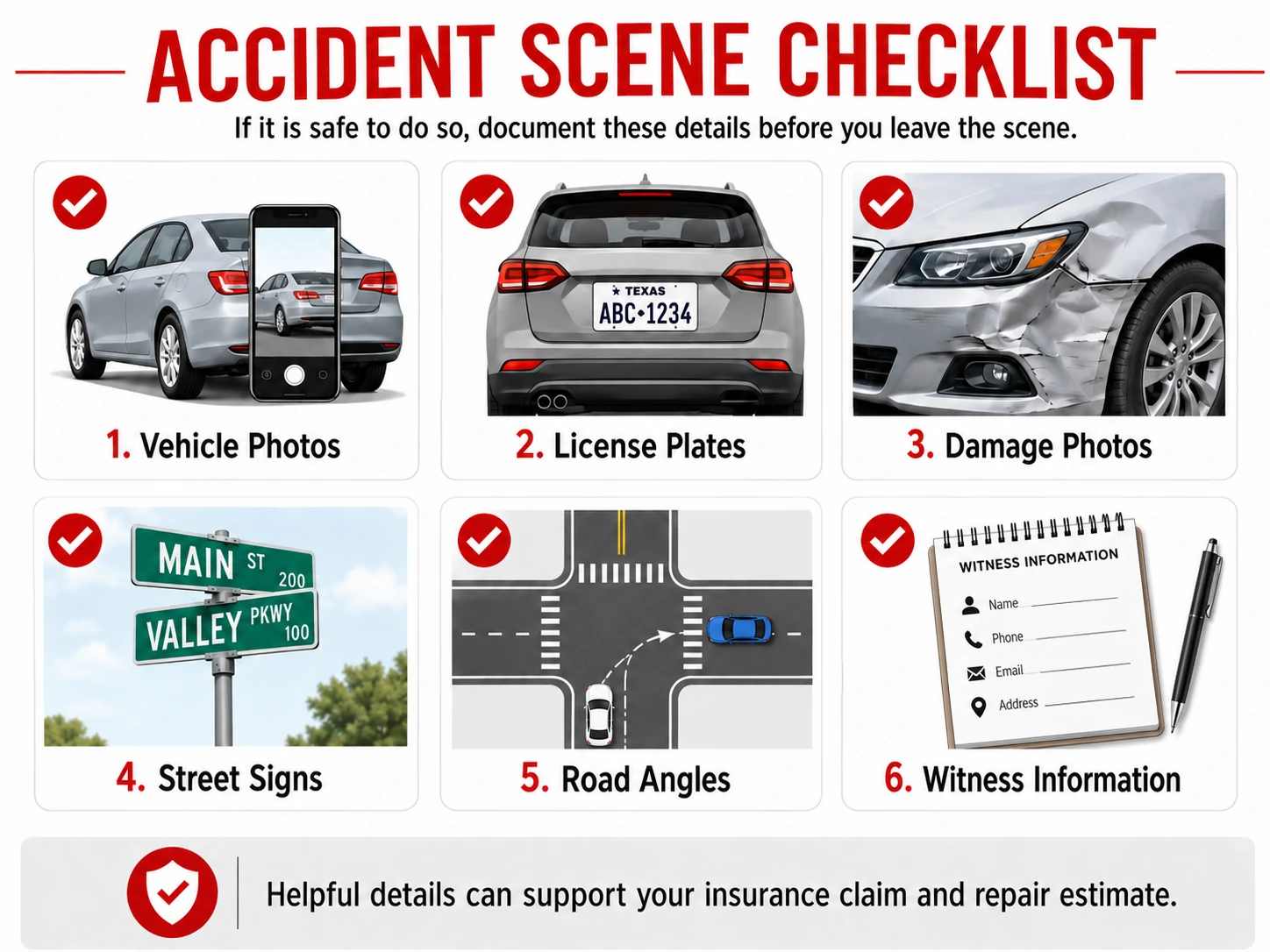
Many accident checklists simply say “take pictures.” TDI is more specific. Its auto-claim guidance says to photograph the other vehicles, license plates, and damage, but also to photograph street signs and road angles. TDI also recommends gathering witness names and phone numbers and writing down the location, time, weather conditions, and what happened.[6]
Photograph
- Each vehicle involved
- License plates
- Visible vehicle damage
- Street signs
- Road angles and the scene layout
Write Down or Collect
- The other driver's insurance and license information
- Witness names and phone numbers
- The exact location
- The time and weather conditions
- Your notes about what happened
TDI specifically includes them in its photo guidance.[6] They help preserve more context than close-up damage photos alone. That does not determine fault by itself, but it creates a better record of the scene.
3. Towing After a Lewisville Wreck: Destination, Tow Ticket & Vehicle Access
Can you tell the tow operator where to take the car?
According to TDI, if the car cannot be driven and police call a tow truck, you can tell the tow operator to take it to a storage lot or body shop of your choice.[6]
A tow destination is an early repair decision
If you already know which collision repair shop in Lewisville you want to inspect the vehicle, tell the tow operator clearly. If the vehicle is taken to storage first, get the facility name and location before you leave the scene.
If the vehicle is already at a storage facility
TDLR says a consumer whose vehicle was towed from a traffic accident or incident is entitled to a copy of the tow ticket. Its towing guidance also says charges on the tow ticket must be itemized and directly related to towing.[11]
For a vehicle at a licensed vehicle storage facility, TDLR says an owner or authorized user who demonstrates ownership or the right to possess the vehicle must be allowed to inspect the tow ticket, remove personal items unless law enforcement prohibits it, and access the vehicle during normal business hours for insurance and/or repair estimates without an access fee. TDLR also says the applicable nonconsent tow fee schedule must be provided on request.[12]
- Ask to inspect the tow ticket.
- Ask for the applicable tow fee schedule.
- Ask for itemized towing and storage charges.
- Request access during normal business hours for an insurance or repair estimate.
- Ask about retrieving personal property from the vehicle.
TDLR also states that when storage results from a law-enforcement-initiated tow, a vehicle storage facility may not ask the owner or operator to sign an authorization for towing, repair, or another service.[12]
Your vehicle being stored somewhere after a law-enforcement-initiated tow is not the same thing as you authorizing that facility to repair it. The TDLR rule above is one reason to read every document before signing it.
4. Can the Insurance Company Choose Your Body Shop in Texas?
Texas' required motor-vehicle repair notice states that you have the right to select where your vehicle is repaired and the parts used for repairs. The same notice says an insurance company is not required to pay more than a reasonable amount for the repairs and parts.[7]
TDI separately tells consumers that an insurance company might provide a list of body shops, but the driver can take the vehicle to any shop. TDI has also reminded insurers that they must not directly or indirectly require a claimant to use a specific facility or a facility on the insurer's preferred list for damage repair or parts replacement to be covered.[6][16]
You can choose the repair facility. That does not automatically mean the insurer must agree to every dollar in a repair plan. Texas' official notice protects the repair choice while also including the reasonable-amount limitation.[7]
If you are comparing shops, look beyond whether a shop says it “works with insurance.” Ask how the shop documents repair needs, handles an updated estimate, and determines which vehicle-specific repair information applies. Lone Star provides insurance claim support and collision repair in Lewisville.
5. The Insurance Estimate Is Lower Than the Repair Cost. What Happens Next?
TDI's wreck guidance gives a straightforward explanation: the insurance company provides a repair estimate. If the repair costs more, the body shop gives the insurance company a new estimate. TDI says the company pays for the extra repairs if it agrees with the new estimate.[6]
TDI also tells consumers to show the body shop the insurance company's estimate and to talk with the insurer about differences or other damage the shop found that the adjuster did not.[8]
The first estimate is not necessarily the last repair document
The Texas Department of Insurance explicitly describes a process in which repair costs can change and a body shop can provide a new estimate to the insurer.[6] This is a more accurate explanation than promising that every additional cost will automatically be covered.
Need help reviewing vehicle damage after an accident? You can send photos to Lone Star online. Photos are a useful starting point, while the repair plan may change as the vehicle and applicable repair needs are evaluated.
6. Are You Filing With Your Insurer or the Other Driver's Insurer?
This distinction matters because the Texas claim-processing deadlines described by TDI for your own insurer do not apply when another driver's insurance company is paying the claim.[8]
Claim With Your Own Insurance Company
TDI says your company has 15 business days to acknowledge the claim, start its review, and ask for needed information. After receiving what it needs, the company generally has 15 business days to tell you whether it will pay, with a possible 45-day extension if it explains why more time is needed. After agreeing to pay all or part of the claim, it generally must pay within five business days.[8]
Claim With the Other Driver's Insurance Company
TDI says the deadlines described for your own company do not apply when another driver's insurer is paying. TDI also notes that you do not have a contract with the other driver's insurance company and may not have the same options you have with your own insurer.[8][10]
If the other driver's insurer refuses to pay, TDI advises asking for the reason in detail and in writing. TDI's consumer guidance also discusses using your own collision coverage, when available, as another route.[10]
7. What If You Disagree With the Insurance Company's Damage Amount?
TDI says the first step is to try to resolve the issue with your adjuster or insurance company. Its claim guidance recommends providing documentation that supports your position. TDI also tells consumers to discuss differences and other damage found by the body shop with the insurer.[8][9]
Some auto policies may include appraisal
TDI says an auto policy may include an appraisal process. In that process, the policyholder and insurance company hire separate damage appraisers, who choose an umpire. The appraisal decision is binding on the amount of damage, but a dispute about what the policy covers can continue after appraisal. TDI says the policyholder pays for their appraiser and half of the umpire's costs.[9]
8. Why a Bumper or Body Repair Can Involve Cameras, Radar & Other Sensors
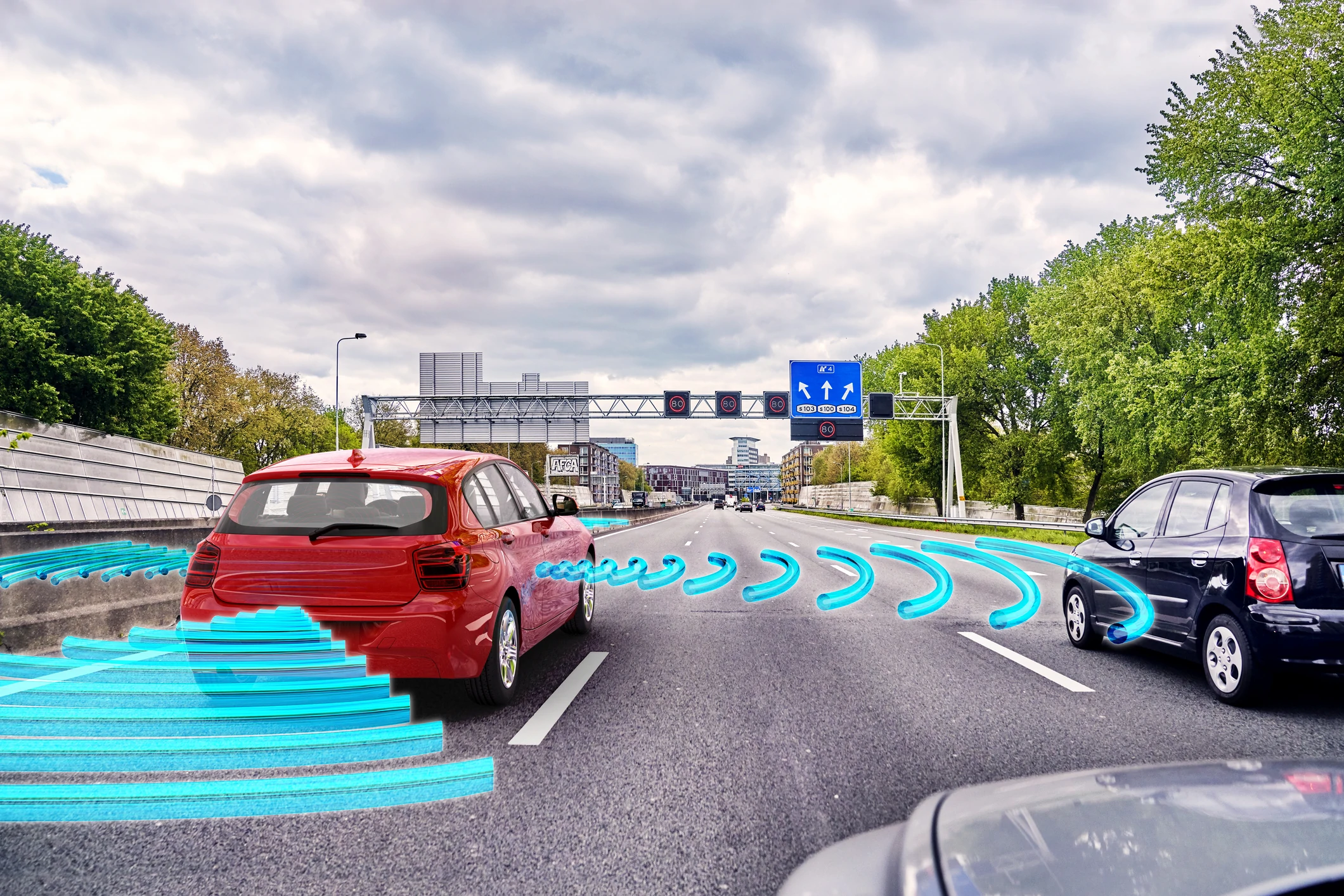
NHTSA describes driver-assistance features that use cameras and other sensors. For example, NHTSA says rear automatic braking uses sensors such as parking sensors and a backup camera, and blind-spot technology can use rear-facing cameras or proximity sensors.[13]
That does not mean every collision requires the same scan or calibration procedure. Manufacturer requirements can vary by vehicle, equipment, damage area, and repair procedure. Two OEM examples show why vehicle-specific repair information matters.
Honda and Acura example: warning lights are not the diagnostic standard
American Honda's July 2025 position statement says mechanical forces in a collision can damage electrical circuits and components in ways that are not easily diagnosed visually. For the Honda and Acura vehicles covered by its statement, Honda says the presence or absence of dashboard indicators or warning lights is not an acceptable method for deciding whether post-collision diagnostic scans are necessary.[14]
It proves what American Honda requires for the Honda and Acura vehicles covered by that position statement.[14] It does not create a universal rule for every make, model, model year, or repair.
Toyota example: rear bumper damage can intersect with Blind Spot Monitor requirements
Toyota collision-repair material explains that bumper decisions can change when Blind Spot Monitoring equipment is involved. Toyota's guidance says vehicle-specific damage diagnosis and repair information should be researched. In the example it provides, damage around the rear bumper's Blind Spot Monitoring control module calls for bumper replacement. Toyota also explains that a repair near a sensor can affect system performance and that repair materials and coating thickness in the sensor's irradiation area can matter.[15]
A separate Toyota collision-repair publication explains that a Blind Spot Monitor sensor behind a rear bumper cover could be damaged or misaligned after a collision and says calibration procedures vary based on what was repaired and what needs to be calibrated.[17]
The better consumer question is not “Does every car need calibration?”
A better question is: What does the applicable manufacturer repair information require for this vehicle and this repair? The Honda and Toyota examples above show why broad, one-size-fits-all claims are not helpful.[14][15]
For damage involving a bumper, body panel, structure, or alignment concern, see Lone Star's bumper repair, auto body repair, and frame repair and straightening services.
9. Lewisville Crash Data: What Five Years of TxDOT Reports Show
We reviewed TxDOT's annual Crashes and Injuries by Cities and Towns tables for Lewisville from 2020 through 2024. TxDOT says these reports contain reportable data collected from Texas Peace Officer's Crash Reports that were received and processed by the department.[1][2][3][4][5]
| Year | Reportable Crashes | Source |
|---|---|---|
| 2020 | 1,841 | TxDOT [1] |
| 2021 | 2,114 | TxDOT [2] |
| 2022 | 2,487 | TxDOT [3] |
| 2023 | 2,474 | TxDOT [4] |
| 2024 | 2,435 | TxDOT [5] |
Our analysis: The published crash count rose from 1,841 in 2020 to 2,487 in 2022, then stayed near that higher level in 2023 and 2024. We calculate a five-year total of 11,351 reportable crashes from the annual TxDOT figures.[1][2][3][4][5]
What 2024's “non-injury” classification does not tell us
TxDOT's 2024 table lists 1,650 non-injury crashes out of 2,435 total reportable Lewisville crashes. We calculate that as approximately 67.8%.[5]
That classification describes reported injury severity. We are not using it as a measure of vehicle damage or repair cost. The table does not tell us that those 1,650 crashes were “minor fender benders.”
10. Questions to Ask Before Authorizing Collision Repair
The sources above point to a more useful set of questions than simply asking whether a shop “works with insurance.” The following list is our synthesis of the TDI, NHTSA, Honda, and Toyota information cited throughout this guide.
About the Repair Plan
- What happens if the documented repair cost changes after work begins?
- Who sends an updated estimate to the insurance company?
- Which vehicle-specific manufacturer procedures apply to the damaged area?
About Vehicle Systems
- Are cameras, radar units, or other sensors located in or near the damaged area?
- Does the applicable OEM information call for scanning, inspection, aiming, or calibration?
- How will required post-repair checks be documented?
A qualified repair discussion should be specific to the vehicle and damage, not built around a universal promise that every car needs the exact same procedure.
11. Lewisville Collision Repair & Insurance FAQs
Can my insurance company choose my body shop in Texas?
Texas insurance guidance states that you have the right to choose where your vehicle is repaired. An insurer may provide a body-shop list, but TDI says you can take the vehicle to any shop. Texas' required repair notice also says the insurer is not required to pay more than a reasonable amount for repairs and parts.[6][7]
What happens if the repair costs more than the insurance estimate?
TDI says the body shop can give the insurance company a new estimate. The insurer pays for the additional repairs if it agrees with that estimate.[6]
Can I choose where my car is towed after a wreck?
TDI says that if the car cannot be driven and police call a tow truck, you can tell the tow operator to take it to a storage lot or body shop of your choice.[6]
Can I access my car at a Texas vehicle storage facility for an estimate?
TDLR says that during normal business hours, a licensed vehicle storage facility must allow access for an insurance and/or repair estimate without an access fee when the person demonstrates ownership or the right to possess the vehicle.[12]
Do the same insurance claim deadlines apply when the other driver is at fault?
TDI says the claim-processing deadlines it lists for your own insurer do not apply when another driver's insurance company is paying the claim.[8]
Does every collision require ADAS calibration?
No single rule applies to every vehicle and repair. NHTSA documents that many driver-assistance technologies use cameras and sensors, while Honda and Toyota publish manufacturer-specific collision repair requirements and examples. The applicable repair information should be checked for the specific vehicle and procedure.[13][14][15]
12. Official Sources & References
The factual claims in this guide are tied to the numbered sources below. External links open the official source in a new tab.
- TxDOT: Crashes and Injuries by Cities and Towns, 2020.
- TxDOT: Crashes and Injuries by Cities and Towns, 2021.
- TxDOT: Crashes and Injuries by Cities and Towns, 2022.
- TxDOT: Crashes and Injuries by Cities and Towns, 2023.
- TxDOT: Crashes and Injuries by Cities and Towns, 2024.
- Texas Department of Insurance: Were you in a wreck? Tips for auto insurance claims.
- Texas Department of Insurance: 28 TAC §5.501, required motor vehicle repair rights notice.
- Texas Department of Insurance: Steps to getting your home or car insurance claim paid.
- Texas Department of Insurance: What if my insurance isn't paying enough?
- Texas Department of Insurance: Accident not your fault? How to deal with the other driver's insurance.
- Texas Department of Licensing and Regulation: Consumer Information about Towing.
- Texas Department of Licensing and Regulation: Vehicle Storage Facilities: Providing Access to a Vehicle.
- NHTSA: Driver Assistance Technologies.
- American Honda Motor Co.: Post-Collision Diagnostic Scan and Calibration Requirements for Honda and Acura Vehicles, July 2025.
- Toyota Collision Pros: Toyota Bumper Repair with ADAS: Repair or Replace It?
- Texas Department of Insurance: Commissioner's Bulletin B-0026-11 on motor vehicle repair facility selection.
- Toyota Collision Pros: Toyota Safety System Calibration.